
At Novena ENT, we meet many patients who are unsure about what a professional hearing evaluation involves. Some feel nervous, while others simply want to understand why their hearing seems different from before. A proper assessment is the first and most important step toward protecting your long-term ear health. Our goal is to make every hearing test Singapore patients attend clear, comfortable, and informative. From the moment you walk into our clinic, we guide you through a structured process designed to identify the cause of hearing loss and recommend the most suitable treatment.
Key Takeaways
- Hearing loss usually develops gradually, so early assessment catches problems before they worsen
- A full ENT hearing assessment covers six steps: consultation, physical ear exam, basic screening, pure tone audiometry, speech testing, and additional diagnostics if needed
- Results are classified as conductive, sensorineural, or mixed, and each type points to a different treatment
- Treatment options after diagnosis include medication, minor procedures, hearing aids, or implant referral
Why a Hearing Assessment Matters
When hearing starts to change, it often happens gradually. You may notice you are asking people to repeat themselves or turning the television louder than usual. These small signs can point to a bigger issue. Without early detection, hearing loss may worsen and begin to affect communication, work performance, and emotional well-being.
We always encourage patients not to delay. By visiting a skilled ear specialist clinic Singapore, you gain accurate answers, professional advice, and access to modern solutions that can dramatically improve daily life.
What Makes Our Approach Different
At Novena ENT, we believe a hearing assessment should never feel rushed or confusing. Good care takes time, clarity, and respect for the individual sitting in front of us. We combine medical capability with advanced diagnostic tools and, just as importantly, proper patient education. Every hearing test Singapore appointment is personalised because no two pairs of ears or lives are the same.
Our team has managed everything from mild, temporary changes in hearing to complex and long-standing loss. Whatever the situation, we explain findings in plain language. You’ll understand what we see, what it means, and what can be done. When patients are well informed, they make decisions with confidence.

Step-by-Step: What Happens During Your Hearing Test
Many people feel more relaxed once they know what to expect. A clear process removes uncertainty and helps you focus on the results rather than the procedure itself. Here’s how we usually carry out a comprehensive assessment.
Step 1: Detailed Consultation
We start by listening to you. Your ear specialist will ask about your symptoms, medical background, lifestyle, and any exposure to loud environments. We may also talk about dizziness, ringing in the ears, previous infections, or recent travel.
This conversation is more important than many people realise. It allows us to narrow down potential causes and decide which tests will give the most useful information. In some cases, the discussion alone already provides valuable clues.
Step 2: Physical Ear Examination
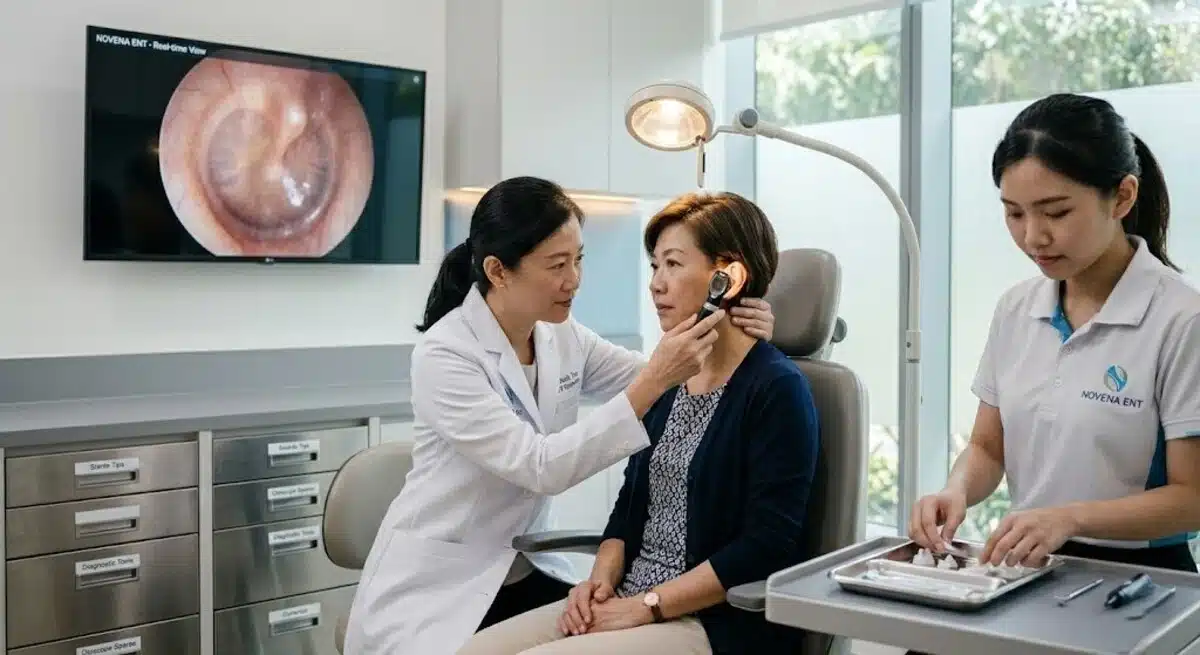
Next, we take a close look at the ear canal and eardrum using specialised equipment. Straightforward issues such as wax impaction, trapped fluid, or minor infections can sometimes create symptoms that resemble more serious conditions.
If we identify something simple, we can often recommend treatment immediately. That means you may not need further diagnostic work at all. When more evaluation is required, we proceed with a clearer understanding of what we’re looking for.
Step 3: Basic Hearing Screening
The screening stage offers a quick snapshot of your hearing ability. Think of it as an overview that tells us whether deeper testing is necessary.
Patients often find this part reassuring. It’s painless, easy to follow, and gives early insight into how well you’re hearing at different levels.
Step 4: Pure Tone Audiometry
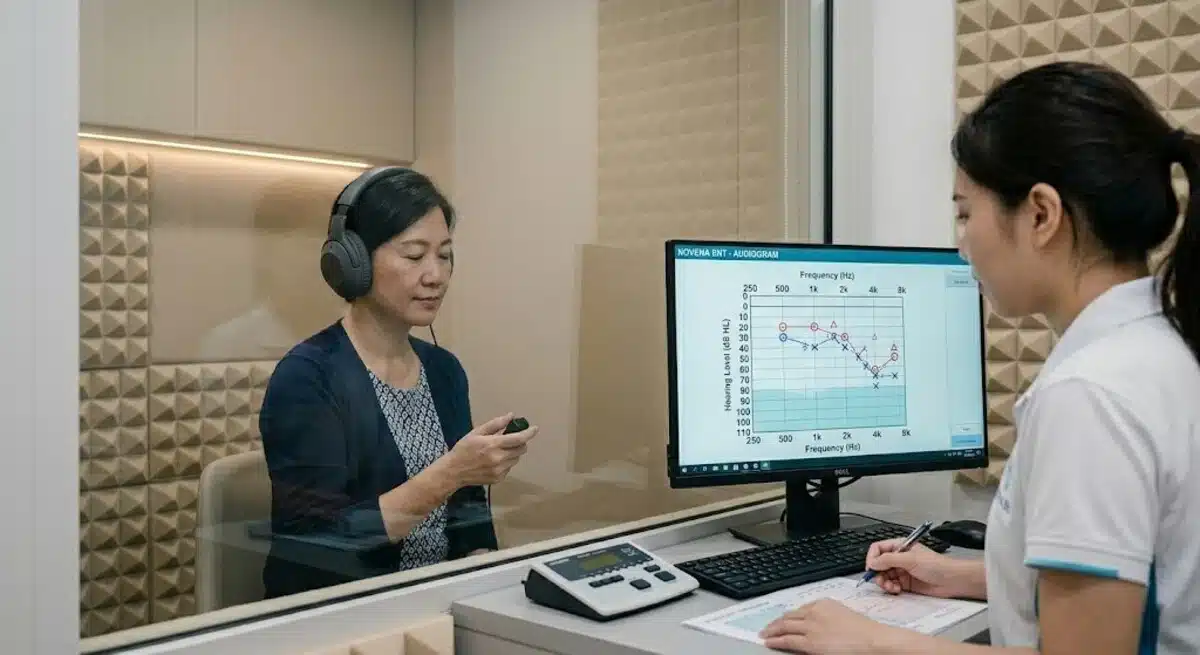
This is the part many people recognise. You’ll wear headphones and listen to sounds presented at various pitches and volumes. Each time you hear a tone, you respond.
From there, we map your hearing thresholds. The information helps us determine both the degree of loss and the type. That distinction matters because treatment for one condition may be very different from another.
Step 5: Speech Testing
Hearing isn’t only about detecting beeps. It’s about understanding conversations with family, colleagues, and friends.
During speech testing, we evaluate how clearly you can recognise and repeat words at different sound levels. These results guide us toward practical recommendations that improve communication in daily life, not just performance on a chart.
Step 6: Additional Diagnostic Tests (If Needed)
Depending on your condition, we may conduct tympanometry or other specialised evaluations to check middle ear function. These provide deeper insight into what might be contributing to your symptoms.
Every advanced hearing test Singapore patients undergo at our clinic is performed with precision and explained carefully.
Quick Overview of the Assessment Process
| Stage | What We Do | Why It Matters |
|---|---|---|
| Consultation | Discuss symptoms & history | Identify risk factors |
| Ear exam | Check the canal & eardrum | Detect blockages or infection |
| Audiometry | Measure sound detection | Grade hearing loss |
| Speech test | Assess the clarity of words | Guide treatment decisions |
Understanding Your Results
We will talk to you about the results after the tests are done. We tell you if your hearing is normal or if you have hearing loss. If there is a problem, we make it clear whether it is conductive, sensorineural, or mixed.
Our ear specialist Singapore will outline the next steps and answer all your questions. We want you to leave feeling informed, not overwhelmed.
What Happens After a Diagnosis?
If treatment is necessary, we offer a wide range of solutions. These may include medication, minor procedures, hearing aids, or referral for implant evaluation where appropriate. Because we manage the entire journey, patients appreciate the convenience of receiving continuous care in one place.
Many people who come for a hearing test Singapore visit discover that early management significantly improves their ability to communicate and enjoy daily activities.
Our Commitment to Patient Comfort
We understand that going to the doctor can be scary. That’s why we made our services quick, polite, and helpful. Our team makes sure you’re never alone on your hearing journey, from setting up appointments to follow-up reviews.
At Novena ENT, your comfort and clarity are just as important as clinical accuracy.
When Should You Book a Hearing Test?
You should consider seeing an ear specialist if you:
- Notice difficulty understanding conversations
- Hear ringing or buzzing sounds
- Increase device volumes frequently
- Have a family history of hearing problems
Taking action early stops hearing loss Singapore from getting worse and opens the door to better treatment options.
Take Control of Your Hearing Today
A professional assessment can provide life-changing answers. Whether your symptoms are mild or more noticeable, we are here to help you understand what is happening and what can be done about it.
Now is the time to make your hearing test Singapore appointment if you’ve been putting it off. Come to Novena ENT and let our skilled staff help you hear better, communicate better, and feel more sure of yourself.