

What is Universal Newborn Hearing Screening (UNHS)?
UNHS is a quick and non-invasive test performed at birth to identify possible hearing loss in newborns. Early identification is crucial as the first few months and years of life represent a critical period when a child’s brain is most receptive to auditory input, which is essential for speech, language, and cognitive development.
Without timely detection, it may take years before the impairment becomes noticeable at a later stage of life. Delays in diagnosis and intervention can significantly impact language, learning and psychosocial developments, resulting in communication difficulties and limited educational progress. Thus, early detection of hearing impairment is essential to ensure timely intervention and better developmental outcomes for the child.
Why does my baby need a hearing screening at birth?
Hearing loss is one of the most common birth conditions. In Singapore, research showed approximately 1 in 1000 babies is born with severe to profound hearing loss and about 5 in 1000 have a milder degree of hearing impairment. As hearing plays a critical role in the development of speech, language, and cognitive skills, early screening is essential because hearing loss is a hidden disability that often goes unnoticed without a proper assessment. As a result, diagnosis and intervention may be delayed, significantly affecting the timeline of early intervention and negatively impacting the child’s development.
UNHS is a standard practice here in Singapore and offered to all babies born in hospitals. By screening your baby’s hearing at birth, you enable early identification and provide necessary support, giving your child the best possible start in life during the critical period of brain development when language skills are most effectively acquired. This also improves the chances of a child successfully integrating into mainstream schools and society.
How is the hearing screening done?
Our in-house Audiologist performs the Automated Auditory Brainstem Response (AABR) screening test to measure how the auditory nerve and brain respond to sound. The test is safe and does not cause any discomfort in newborns. It is usually done while the baby is quiet and asleep.
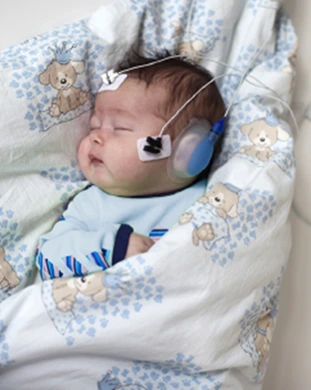
To begin the test, specific areas of the skin are gently scrubbed to ensure proper electrode contact. After scrubbing with the scrub gel, three small jelly tab electrodes are placed on the baby’s forehead, cheekbone, and the back of the neck to measure brain activity in response to sound. Soft ear couplers are placed on each ear to present a series of soft clicking sounds.
AABR test assesses the hearing pathway from the ear to the brainstem in both ears by measuring how the auditory nerve and brain respond to sounds presented.
What does it mean if my baby passes or fails the hearing screening?
A pass result indicates normal hearing at the time of testing. Parents are advised to monitor the child’s hearing and language milestones as some babies may develop hearing loss later in life due to factors such as ear infections or chronic illnesses.
A fail result does not automatically mean that your baby has a hearing loss but it does warrant further testing and subsequent management by an ENT (Ear, Nose, and Throat) specialist. The diagnostic testing is performed by an Audiologist to determine if there is a hearing loss, the cause of it and its impact on the baby’s functional hearing.
Can I wait to test my baby’s hearing?
The Joint Committee on Infant Hearing (JCIH) recommends the 1-2-3 timeline to strive for earlier detection of hearing loss in infants and maximize early language development with the most effective support possible.

- By 1 Month of Age: Hearing screening should be completed.
- By 2 Months of Age: Infants who fail the initial screening should undergo a full audiological evaluation to confirm the diagnosis and severity of the hearing loss.
- By 3 Months of Age: Infants diagnosed with hearing loss should begin receiving appropriate early intervention services to support speech, language, and social development.
Early intervention for hearing loss in children involves fitting of amplification devices like paediatric hearing aids, potentially cochlear implants and aural habilitation such as Auditory-Verbal Therapy.